
There are times when you don’t have a direct shot: a ball is blocking the path or the object ball is hidden. That’s where playing off the rail makes the difference between giving up the table and getting out of the trap. I’ll show you how to figure out the angle and how to practice it.
In one sentence
To play off the rail, imagine the rail is a mirror: the spot you need to aim at is the reflection of the object ball (or the pocket) on the other side of the rail; then adjust for speed and spin, which open or close the rebound angle.
Bank shots and kick shots
- Bank shot: you hit the object ball with the cue ball so the object ball comes off one or more rails before it goes in.
- Kick shot: the cue ball hits one or more rails first and then hits the object ball. It’s the go-to shot for getting out of your opponent’s safety.

The angle in and the angle out
The basic idea: a ball that hits the rail with no spin at medium speed comes off at roughly the same angle it went in, like light in a mirror. It isn’t exact (the rails, the cloth and the speed all change it), but it’s the starting point for working out any rail shot.
The mirror method
- Imagine the rail is a mirror.
- Find the reflection of the object ball on the other side of the rail, the same distance from the rail as the real ball.
- Aim the cue ball at that reflection: where the line crosses the rail is where the cue ball needs to hit.
- For a bank shot, do the same with the pocket: aim the object ball at the reflection of the pocket.
What the diamonds are for
The diamonds, or markers on the rails, are evenly spaced, so they work like a ruler. For example, if the cue ball and the object ball are the same distance from the rail, the contact point is right in the middle between them, and the diamonds help you find it accurately. The more advanced diamond systems (for multi-rail shots) are pro-level material and are used a lot in three-cushion carom.
How speed and spin change things
- More speed: the rail compresses more and the ball tends to come off at a shorter angle.
- Running english (side spin toward the direction the ball is heading): opens up the rebound angle.
- Reverse english: closes it.
That’s why, when you’re learning, you should always start with no spin and medium speed. Once you’ve got the angle under control, bring in side spin and learn to compensate for it. If you’re torn between kicking, jumping or curving the ball, read how to decide.
Drills
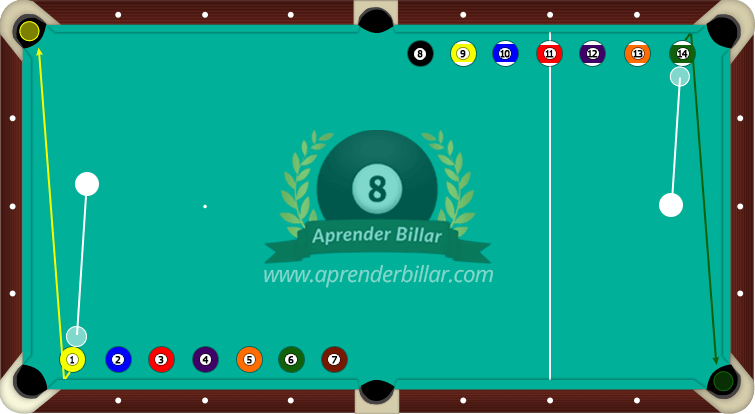
Bank shots
- Put the cue ball behind the target ball and bank it in.
- Work from the bottom up.
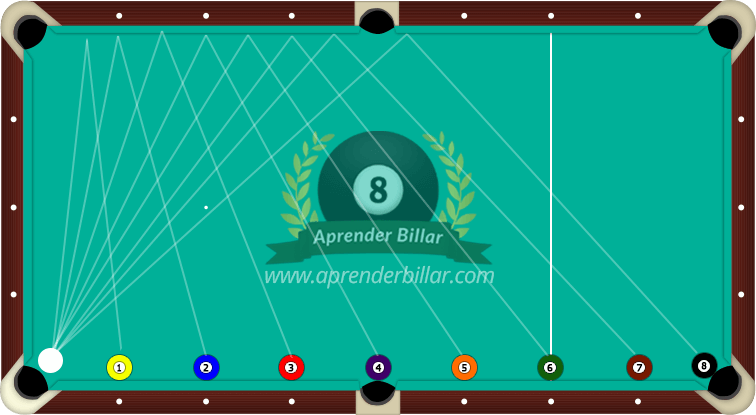
Kick shots
- Hit the rail first and contact the 1-ball; then the 2, and so on.
They’re part of the semi-pro practice plan.
FAQ
What’s the difference between a bank shot and a kick shot?
In a bank shot, the object ball is the one that hits the rail; in a kick shot, the cue ball hits the rail first.
Is the angle out the same as the angle in?
Roughly, if you shoot with no spin at medium speed. Speed and spin change it.