
In one sentence
Blackball, or English eight-ball, is a British version of 8-ball played with seven reds, seven yellows and the black, on a smaller table, with its own foul rules.
What is blackball?
It’s also called English eight-ball or English pool.
It’s a two-player game similar to 8-ball, played on a table with seven red balls, seven yellow balls and one black (the 8-ball).
The object of the game
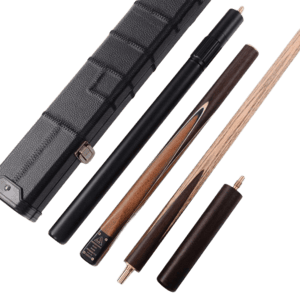
Like American pool, it’s played with a cue, but players usually use a snooker-style cue.
Remember that a snooker cue is about 57 to 58 inches (around 145 cm) and often has removable extensions that make it about 6 inches (15 cm) longer.
The cue ball is used to break the rack at the start.
The cue ball must then contact a red or yellow ball and send it, directly or indirectly (with a bank or kick shot), into one of the six pockets.
The first player to pocket all their balls (reds or yellows) then has to pocket the black to win the game.
Turns
Players take turns.
If a player pockets one of their own balls without fouling, they keep shooting.
If they don’t pocket one of their balls, accidentally pocket an opponent’s ball or foul, it’s the opponent’s turn.
Under the traditional rules, if a player scratches at any point, the opponent comes to the table and gets two shots.
Starting the game
The game starts with all the balls (except the cue ball) racked in a triangle, with the black in the middle of the rack, on the spot.
The player breaking places the cue ball anywhere in the baulk area (the kitchen).

Open table and choosing groups
The table is “open” when the players’ groups haven’t been decided yet.
The table is open after the break and stays open until the shooter pockets balls from only one group on a normal, legal shot.
That means not the break shot and not a free shot.
The shooter is then assigned that group of balls, and the opponent gets the other group.
Calling a snooker
A player is snookered when the cue ball doesn’t have a clear, straight path to hit at least part of a legal object ball.
The snooker has to be called by the referee to take effect, or agreed with your opponent in a casual game.
Fouls in blackball
- When a player breaks to start the game, at least two balls (not counting the cue ball) must reach a cushion, or at least one ball must be pocketed. If not, it’s a foul: the balls are re-racked and the opponent gets the chance to break.
- If the breaker scratches on the break, no matter how many other balls went in, it’s a foul: it’s the opponent’s turn and they get an extra shot (2 shots).
- If a player scratches at any point in the game, they lose their turn. The cue ball comes out of the pocket and goes to the opponent, who can place it anywhere in baulk and shoot at any ball (even the black). The opponent also gets an extra shot, meaning two shots.
- After that, if a player pockets only one of the opponent’s balls, it’s a foul. The player loses their turn and the opponent gets an extra shot (2 shots).
- If a player pockets the black before clearing all of their own group (reds or yellows), they lose the game immediately.
- If a player hits the cue ball and it doesn’t then contact any of the player’s own balls on the table, it’s a foul. The player loses their turn and the opponent gets an extra shot.
- If the cue ball contacts one of the opponent’s balls FIRST, it’s a foul, even if the player pocketed one of their own balls on the shot. The player loses their turn and the opponent gets an extra shot.
- If the cue ball contacts the black first, it’s a foul, unless the black is the shooter’s last ball on the table. The player loses their turn and the opponent gets an extra shot.
- Rules differ on pocketing your last ball and the black on the same shot, so agree on it before you start; the official rulebook below settles it for tournament play.